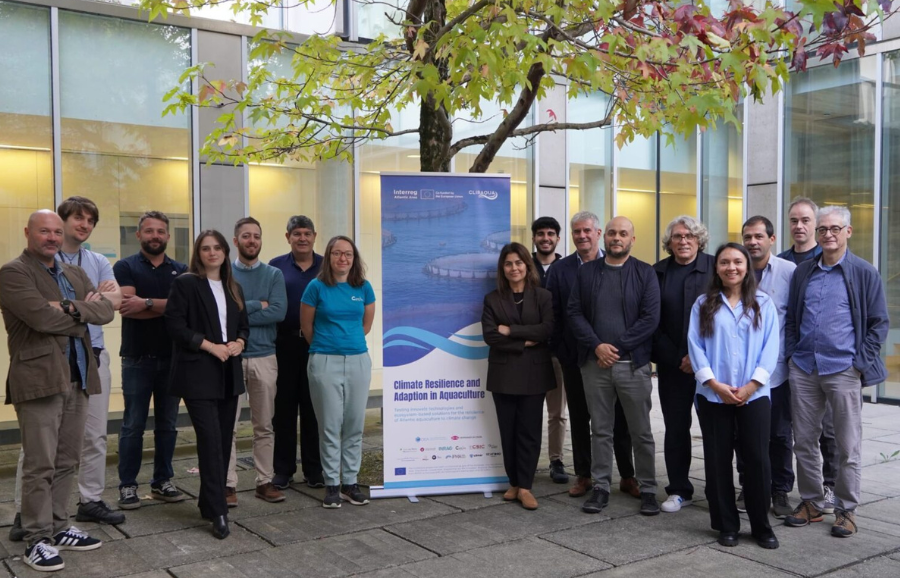
The CLIRAQUA project, led by the Interdisciplinary Centre for Chemistry and Biology (CICA) at the University of A Coruña and supported by the Interreg Atlantic Area Programme, carried out its first scientific field campaign in the São Jorge Lagoon Ecosystem (Azores, Portugal) in May. The campaign aims to help develop new ways for aquaculture systems in Atlantic island regions to adapt to the effects of climate change.
During the field campaign, researchers from the University of the Azores (UAc) and CIBIO-Açores, with support from the Association of Clam Producers of Fajã de Santo Cristo, the Regional Directorate for Environment and Climate Action, and the Regional Directorate for Fisheries, installed sensors in different parts of the lagoon. These sensors will continuously measure important water conditions, including temperature, dissolved oxygen, conductivity, and salinity.
The team also collected samples of the clam species Ruditapes decussatus and measured several physical and chemical characteristics of the water at different locations across the lagoon.
The clams were then transported to the laboratories of the Portuguese Institute for the Sea and the Atmosphere (IPMA) in Lisbon. There, scientists are conducting experiments to study how extreme marine weather events (e.g., heatwaves, cold spells, severe rainfall) and changes in salinity affect this species, which is important for both the ecosystem and local economic activities.
The results of this work will help researchers better understand how climate change may affect coastal aquaculture and support the development of practical solutions to make these systems more resilient in the future.
During the field campaign, researchers from the University of the Azores (UAc) and CIBIO-Açores, with support from the Association of Clam Producers of Fajã de Santo Cristo, the Regional Directorate for Environment and Climate Action, and the Regional Directorate for Fisheries, installed sensors in different parts of the lagoon. These sensors will continuously measure important water conditions, including temperature, dissolved oxygen, conductivity, and salinity.
The team also collected samples of the clam species Ruditapes decussatus and measured several physical and chemical characteristics of the water at different locations across the lagoon.
The clams were then transported to the laboratories of the Portuguese Institute for the Sea and the Atmosphere (IPMA) in Lisbon. There, scientists are conducting experiments to study how extreme marine weather events (e.g., heatwaves, cold spells, severe rainfall) and changes in salinity affect this species, which is important for both the ecosystem and local economic activities.
The results of this work will help researchers better understand how climate change may affect coastal aquaculture and support the development of practical solutions to make these systems more resilient in the future.
Publish date: 2026-06-26