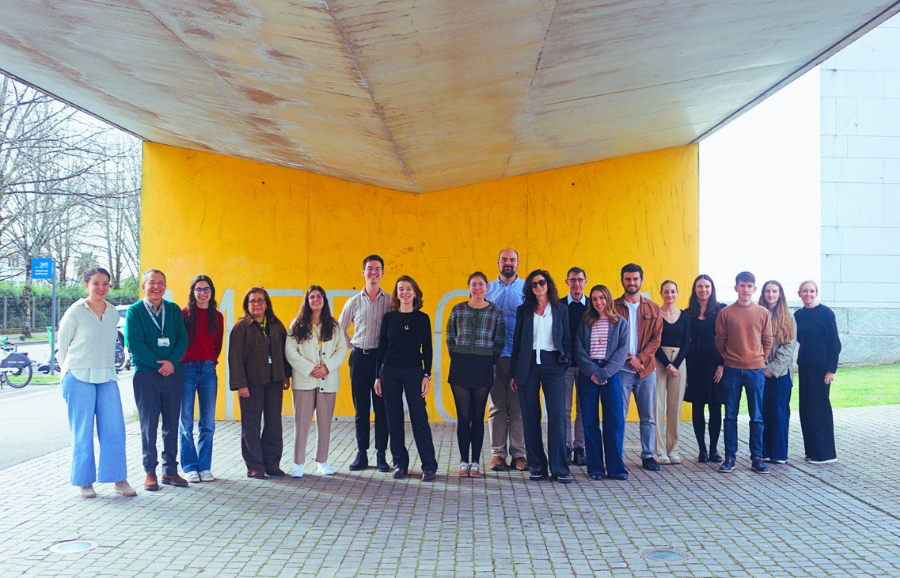
From 15–18 June 2026, the University of Pau and the Pays de l'Adour (UPPA), a partner in the Interreg Atlantic Area-funded BOTS project, hosted the BOTS Summer School in Biarritz and Anglet. Bringing together master's students, doctoral researchers, early-career scientists and international experts, the event explored the role of innovative biomaterials in developing advanced 3D breast cancer models.
The four-day programme combined scientific lectures, poster sessions, collaborative workshops and networking opportunities, creating an interdisciplinary environment where participants from biology, chemistry, biomaterials and bioengineering exchanged knowledge and explored new approaches to breast cancer research. Discussions focused on 3D cell cultures, organoids, marine biopolymers and other sustainable biomaterials with potential applications in personalised medicine.
The Summer School also featured a public conference, chaired by Professor Susana Fernandes with Professor Richard Iggo as keynote speaker, bringing together researchers, healthcare professionals, patients, associations and members of the public to discuss the latest advances in breast cancer treatment. The event reflected the BOTS project's commitment to engaging both the scientific community and society in addressing one of today's major health challenges.
A highlight of the programme was the BOTS Creathon, an intensive collaborative challenge centred on the question: How can nature-inspired biomaterials improve the development of blood vessel networks (vascularisation) in 3D breast cancer models? Working in multidisciplinary teams, participants drew inspiration from biological systems and natural structures to develop innovative concepts for improving vascularisation in 3D breast cancer models. Supported by expert mentors, they combined scientific knowledge, engineering principles and creative thinking before presenting their ideas to a panel of judges. Awards recognised the most innovative, bio-inspired and feasible projects, celebrating solutions with strong potential for future research and real-world application.
Participants testimonials
The collaborative atmosphere was one of the aspects participants valued most. As post-doctoral researcher Upashi Goswami explained, "Interacting with chemists and biologists broadened my perspective and opened up new opportunities for future collaboration." For Dr María Vivanco, Group Leader of the Cancer Heterogeneity Lab at CIC bioGUNE and one of the Summer School speakers, the informal format was equally important: "Events like the BOTS Summer School create the informal interactions that help build lasting collaborations and make interdisciplinary science possible."
The four-day programme combined scientific lectures, poster sessions, collaborative workshops and networking opportunities, creating an interdisciplinary environment where participants from biology, chemistry, biomaterials and bioengineering exchanged knowledge and explored new approaches to breast cancer research. Discussions focused on 3D cell cultures, organoids, marine biopolymers and other sustainable biomaterials with potential applications in personalised medicine.
The Summer School also featured a public conference, chaired by Professor Susana Fernandes with Professor Richard Iggo as keynote speaker, bringing together researchers, healthcare professionals, patients, associations and members of the public to discuss the latest advances in breast cancer treatment. The event reflected the BOTS project's commitment to engaging both the scientific community and society in addressing one of today's major health challenges.
A highlight of the programme was the BOTS Creathon, an intensive collaborative challenge centred on the question: How can nature-inspired biomaterials improve the development of blood vessel networks (vascularisation) in 3D breast cancer models? Working in multidisciplinary teams, participants drew inspiration from biological systems and natural structures to develop innovative concepts for improving vascularisation in 3D breast cancer models. Supported by expert mentors, they combined scientific knowledge, engineering principles and creative thinking before presenting their ideas to a panel of judges. Awards recognised the most innovative, bio-inspired and feasible projects, celebrating solutions with strong potential for future research and real-world application.
Participants testimonials
The collaborative atmosphere was one of the aspects participants valued most. As post-doctoral researcher Upashi Goswami explained, "Interacting with chemists and biologists broadened my perspective and opened up new opportunities for future collaboration." For Dr María Vivanco, Group Leader of the Cancer Heterogeneity Lab at CIC bioGUNE and one of the Summer School speakers, the informal format was equally important: "Events like the BOTS Summer School create the informal interactions that help build lasting collaborations and make interdisciplinary science possible."
Publish date: 2026-06-30