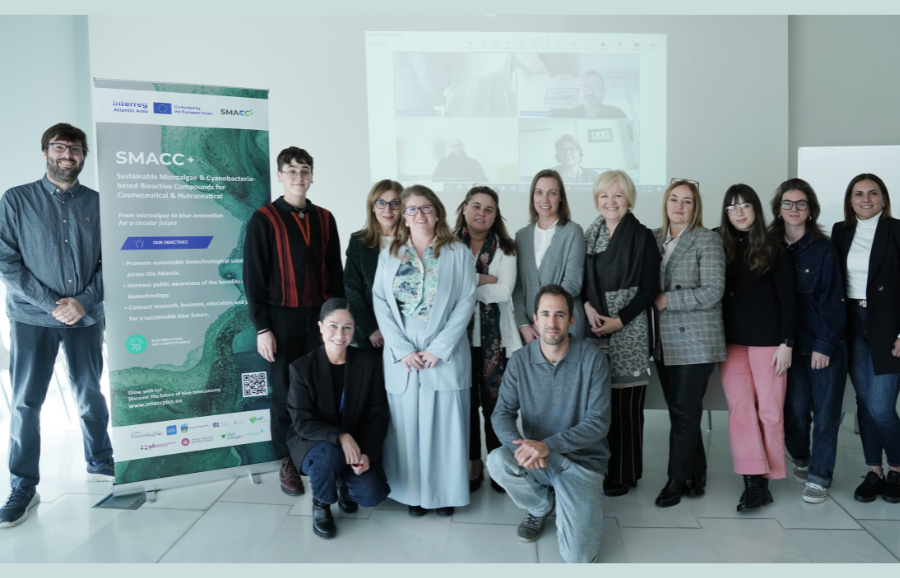
The Interreg Atlantic Area project SMACC+, led by the Universidade de Vigo and funded by the Interreg Atlantic Area Programme, hosted an official EU Green Week 2026 partner event on 8 June. The webinar, "SMACC+: Unlocking the Potential of Microalgae for the Blue Economy", explored how microalgae can contribute to Europe's green and blue transition across sectors such as health, cosmetics, and nutraceuticals.
The event brought together researchers, industry representatives, and European project managers from Spain, France, Ireland, and Germany to exchange knowledge and discuss opportunities for scaling sustainable microalgae-based solutions.
From science to industrial applications
Researchers M. Lourdes Mourelle, Herminia Domínguez, and Víctor Ocampo from the Universidade de Vigo presented the scientific foundations of microalgae and cyanobacteria. They highlighted that, although more than 200,000 species have been identified, only a small number are currently exploited commercially. The speakers also highlighted the environmental benefits of growing microalgae. They explained that each kilogram of microalgae biomass can absorb around 1.83 kilograms of carbon dioxide (CO₂), helping to reduce greenhouse gases in the atmosphere. The presentation explored the valuable substances found in microalgae, including healthy fats, natural pigments, proteins, vitamins, and other bioactive compounds. These substances can be used in products that support heart health and the immune system, as well as in cosmetics that help protect and moisturise the skin.
Scaling the blue bioeconomy
The webinar concluded with a roundtable discussion moderated by Carolina Massara, EU Project Manager at Finnova Foundation. The discussion highlighted several common challenges facing the sector, including regulatory fragmentation, difficulties in scaling up from pilot to commercial production, and the need for stronger coordination between European projects. Participants agreed that greater collaboration across research, industry, and policy communities will be essential to unlock the full potential of microalgae and accelerate the development of a sustainable blue bioeconomy in the Atlantic Area.
The event brought together researchers, industry representatives, and European project managers from Spain, France, Ireland, and Germany to exchange knowledge and discuss opportunities for scaling sustainable microalgae-based solutions.
From science to industrial applications
Researchers M. Lourdes Mourelle, Herminia Domínguez, and Víctor Ocampo from the Universidade de Vigo presented the scientific foundations of microalgae and cyanobacteria. They highlighted that, although more than 200,000 species have been identified, only a small number are currently exploited commercially. The speakers also highlighted the environmental benefits of growing microalgae. They explained that each kilogram of microalgae biomass can absorb around 1.83 kilograms of carbon dioxide (CO₂), helping to reduce greenhouse gases in the atmosphere. The presentation explored the valuable substances found in microalgae, including healthy fats, natural pigments, proteins, vitamins, and other bioactive compounds. These substances can be used in products that support heart health and the immune system, as well as in cosmetics that help protect and moisturise the skin.
Scaling the blue bioeconomy
The webinar concluded with a roundtable discussion moderated by Carolina Massara, EU Project Manager at Finnova Foundation. The discussion highlighted several common challenges facing the sector, including regulatory fragmentation, difficulties in scaling up from pilot to commercial production, and the need for stronger coordination between European projects. Participants agreed that greater collaboration across research, industry, and policy communities will be essential to unlock the full potential of microalgae and accelerate the development of a sustainable blue bioeconomy in the Atlantic Area.
Publish date: 2026-06-17