
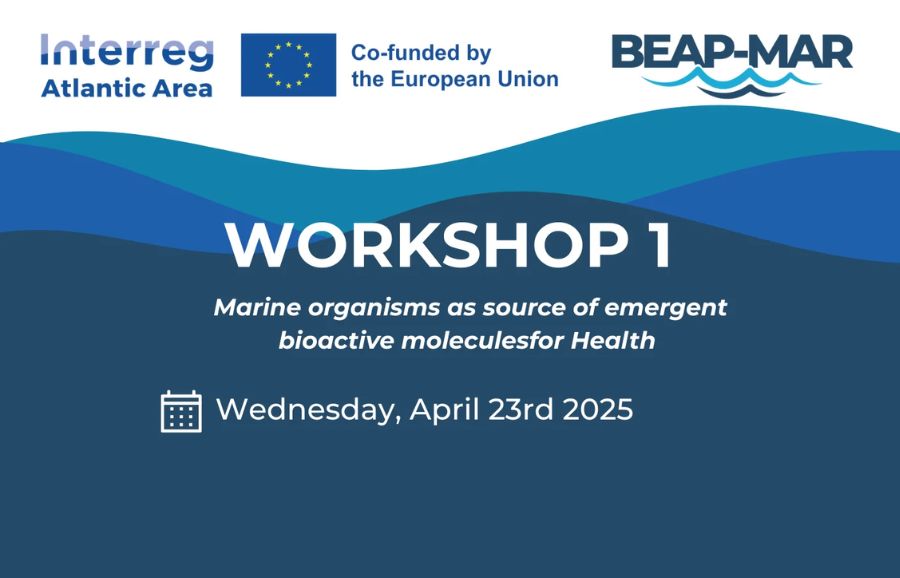
The BEAP-MAR project, led by the Faculty of Veterinary Science of the University of Santiago de Compostela and supported by the Interreg Atlantic Area programme, will present new advances in the blue bioeconomy during the workshop “BEAP-MAR Pillar 4”. The event will highlight innovations that can enhance the performance and competitiveness of project partners across the Atlantic Region.
The workshop will take place on 14 January, from 10:00 to 13:00 (CET), in a hybrid format, both online and in person at the Deputación de Pontevedra, in Spain. It will open with a presentation entitled “The potential of marine compounds for inflammatory diseases”, focusing on the role of marine-derived bioactive compounds in pharmaceutical development.
“Research into marine-derived bioactive compounds demonstrates the vast untapped potential of our oceans for pharmaceutical development. These discoveries highlight why sustainable marine biotechnology is crucial for addressing global health challenges while protecting marine ecosystems,” states the project’s lead partner.
The workshop will also include a session on the importance of synergies in the implementation of projects supported by the Interreg Atlantic Area programme. Carlos Garea, Project Manager, will present the value of a collaborative model that brings together government bodies, industry, academia, and civil society organisations.
The BEAP-MAR project aims to valorise non-traditionally commercially exploited marine organisms, including new strains of microalgae and macroalgae, marine fungi, and sponges. This work will lead to the development of innovative compounds—primarily biomolecules—and sustainable, high added-value products. These outcomes will be implemented through industrial-scale methodologies, enabling organisations in the Atlantic Region to strengthen their capacity to develop new business models and sustainably exploit untapped marine resources.
The workshop will take place on 14 January, from 10:00 to 13:00 (CET), in a hybrid format, both online and in person at the Deputación de Pontevedra, in Spain. It will open with a presentation entitled “The potential of marine compounds for inflammatory diseases”, focusing on the role of marine-derived bioactive compounds in pharmaceutical development.
“Research into marine-derived bioactive compounds demonstrates the vast untapped potential of our oceans for pharmaceutical development. These discoveries highlight why sustainable marine biotechnology is crucial for addressing global health challenges while protecting marine ecosystems,” states the project’s lead partner.
The workshop will also include a session on the importance of synergies in the implementation of projects supported by the Interreg Atlantic Area programme. Carlos Garea, Project Manager, will present the value of a collaborative model that brings together government bodies, industry, academia, and civil society organisations.
The BEAP-MAR project aims to valorise non-traditionally commercially exploited marine organisms, including new strains of microalgae and macroalgae, marine fungi, and sponges. This work will lead to the development of innovative compounds—primarily biomolecules—and sustainable, high added-value products. These outcomes will be implemented through industrial-scale methodologies, enabling organisations in the Atlantic Region to strengthen their capacity to develop new business models and sustainably exploit untapped marine resources.
Related Articles
Events Calendar